Moai on Easter Island

Moai on Easter Island

Friday, June 28, 2013

I've Made it Halfway Through The Antarctic Winter!

Each day is slowly getting a little bit brighter.  Last weekend was the annual midwinter celebration at Scott Base and McMurdo.  The weekend started out at Scott Base with one of the best meals that I have ever eaten.  I lost count, but I believe that there were 7 or 8 courses.  Each course was small (by American standards), but eating that many courses throughout a three hour dinner left everyone feeling extremely satisfied.

One of the main courses at Scott Base's Midwinter dinner.  Thank you Meghan Brown for these two photos.
Just one of the desserts served at Scott Base during Midwinter dinner.

Midwinter dinner at McMurdo was the next day's feast.  Many hours were spent reorganizing and decorating the galley into a travel-themed dining room and dance floor.  Maps and scenes of the world adorned the walls and a model airliner, complete with contrails, streaked above the dining tables.

Since the theme was travel a couple of us decided to dress up like American tourists complete with fanny packs, sandals with socks, lonely planet guidebooks and name tags for our tour group: Antarctic Scenic Services or A.S.S.

We dressed as American tourists as per the travel theme.  Thanks to Deven Stross for the photo.
Each winter base in Antarctica sends out a midwinter greeting to all the other bases on the continent.  Many are further north along the coast of the continent and sent greeting with group photos of the winter-over personnel during a sunset.  McMurdo sent out a generic photo of the station with an invitation to anyone who wanted to bring in fresh salad saying that we'd provide the dressing.  It is sad that an American "research" station in Antarctica won't fund or even allow a greenhouse to be run by volunteers in the winter to provide real food to its residents.

Besides more amazing food and good company my favorite part of the night was taking photos at our little "studio corner" in the back of the galley.  One of my coworkers set up his lights and put up a perfect black backdrop.  I've never been that great at taking people photos so this was a great learning experience for me.  I had a blast taking pictures of everyone and am pleasantly happy with the way the photos turned out.  I'm not as opposed anymore to possibly doing more portrait work in the future.

This is the guy who provided the lighting and set up the photo area.  Thanks Deven.

The weather forecaster and observer for the winter hard at work predicting the weather.


The super moon topped off the weekend.  I know the moon would end up right behind Observation Hill and I've seen photos with the moon silhouetted behind the cross at the top.  I am certainly not religious, but it seemed like a pretty neat photo.  It was cold and windy and I really had no desire to stand outside and take photos, but I walked outside after a meal and the moon was almost in position.  I slowly walked back to my room and took my time getting camera gear ready hoping that the moon would be in the wrong position for this shot.  I walked outside and the moon was in perfect position and I ended up really happy I actually got out and took some photos of this.

The classic Ob Hill full moon photo.

The super moon illuminating the darkest day of the year. 

Every week or so there is a beautiful calm day in McMurdo.  I try to go for a run every time it is calm enough to do so.  This week is the first time that McMurdo has felt like a mountain town to me.  It had been calm all day with low clouds and the weather drew me to free myself from the indoors and go for a run around McMurdo.  The low clouds blocked out the sky and dropped ice crystals all over town as if all the stars had fallen and stuck to the cold ground.  They sparkled just as brightly leaving the same feeling that you get when you look up at a sky full of stars.  

My run took me part way up Ob Hill overlooking McMurdo and I could here the dull roar of the town. It was the same dull roar that any town puts off at night.  The lights of town cast an orange glow on the lower hanging clouds and I momentarily felt at home.  I felt like this was a place, seemingly forgotten at the bottom of the earth, that I might be able to spend some time in.  There have been a few moments in my last nine months there that I've felt this way.

On that note I can't wait for the sun to come up.  Only 52 more days until that happens.

Sunday, June 9, 2013

The coolest ATV ever: The Hagglund

One of the first things that I noticed when I got off the plane in Antarctica was all the strange vehicles around.  Some of them were modified versions of vehicles that many people would see every day such as a Ford F-350 or a passenger bus, but here the F-350 has tracks and the bus has tires as tall as I am.  Others were new to me like the Tucker Sno-cat, Pisten Bully and Hagglund.  Here are two more recent articles by some of my coworkers about the vehicles of Antarctica and Ivan the Terra Bus.


Hagglund 007, also called Moonraker, parked near the wind turbines between McMurdo and Scott Base.

At first I saw the Hagglund as one of the least appealing looking vehicles around.  I saw it as a pretty boring box with tracks.  Unfortunately, sometimes it is hard to be happy with what you have, but I had always wanted to drive all the other types of vehicles that were cruising around town and out on the sea ice.

After a full summer of driving the Hagglund a few times a week, it quickly grew on me.  After driving them all around McMurdo Sound and Ross Island I learned about all the gnarly terrain that these vehicles can cover.  They are supposed to be able to traverse a 30 degree slope before they flip over, but the pucker factor starts just after 10 degrees.   They are also supposed to be amphibious, but the bilge pumps in ours don't work and it really wouldn't make that much of a difference anyway because none of the doors fully seal.  Back on that topic of always wanting more: the Kiwi Hagglund has all of it's working parts AND they have carpeted ceiling!

Hagglund 007 during SAR training on the McMurdo Ice Shelf during a mid-day sunset.

They Hagglund was put into production in 1980 after a couple of prototypes were tested.  This might explain why it looks like a box with a set of tracks.  They are used all over the world primarily for military, search and rescue and firefighting use.  But they seem to be becoming more popular as a recreational vehicle.  If you are so inclined you can purchase one here.

A few other people helped me love the Hagglund even more.  One woman on a recreational trip last summer had worked in McMurdo for a few years and one of the things on her Antarctic bucket list was to ride in a Hagglund.  She was super excited to just sit in the cab and get a few pictures taken, let alone zoom across the bare sea ice at around 20 mph in it.  They are reported to top out at 34mph; I think I've hit 25 or 26mph going downhill.  Stats also say that it can hold 17 people, but with all of our search and rescue gear we can barely fit our whole SAR team of 10 people in it.

During the second medevac this winter the crew from the C-17 took more photos of the Hagglund than anything else at the airfield--granted it was dark and there wasn't much else to see.  I've definitely come to love the Hagglund over the last eight months down here.  One of my favorite parts about the Hagglund is sitting in the backseat with a pair of earmuffs (since the engine is right in the center between the seats) and being lulled to sleep by the smooth rough sound and vibration of the vehicle.  If I don't get to drive any other type of vehicle in Antarctica I'll be pretty happy with the Hagglund.

Even the penguins love the Hagglund.  Penguins waddle and slide up to anything that is new in the environment.  This led to some amazing encounters this summer, but here these penguins soon lost interest in us and headed toward Hagglund 120, otherwise known as Hansel.  Hagglund 121, Gretel, spent most of the summer in the shop.

Thursday, May 30, 2013

Dark

The sun set just over a month ago and the darkness is just now becoming a normal part of life for me.  The faint light on the horizon at noon is just a tease that I wish wasn't there.  It is a hint of sunshine and life beyond the McMurdo city limits.

Long exposures prove that there are still mountains out there.
I was able to get back into something a little more normal for me a week or so ago and actually put on a pair of crampons and grabbed an ice axe.  What used by be an almost daily occurrence suddenly became a huge novelty.  Mike and I went out to an icefall to scout for that week's SAR training.  The crunch of the snow was soothing for me in a way that the sound of traffic is for others.  As we made our way over crevasses and below seracs I felt more alive than I have in the last few months of being in town.

Large parts of McMurdo remain fully illuminated all winter long.
Icefalls always look menacing and scary in the dark.  They are rarely seen in the dark for long.  Eventually the sun will come up turning my imaginary dangers into real ones or washing away any fears I had as if the sun is saying, "it's just a piece of ice silly."

During the day it was still light for weeks after the sun had set for the season.
We used spotlights from the Hagglund to scope out options for traveling through the ice fall.  On the northern horizon, silhouetting Mt Erebus, was the type of glow that you see about two hours before the sun rises.  The first thought that popped into my head was that by the time we actually start hiking it will be light enough to see pretty easily.  This was when it finally hit me that it wasn't getting any lighter for quite awhile.
On calm days fiery columns of exhaust and steam come from most of the buildings.
But now, just a few weeks later, I hardly realize it is dark--in the same way that it didn't strike me as strange when the sun was up all the time during the summer.  Now I know it is supposed to be dark and am almost surprised every time I see the moon in the sky.  It seems out of place since darkness has consumed everything else.  On clear days the moon is beautiful, but I can't help but feel that it is taking something away from that darkness.  It takes something away the same way the faint glow on the norther horizon takes away from the darkening night.  In another month or two I will have different feelings toward that glow since it will be bringing the sun back instead of taking it away.

Tuesday, May 14, 2013

Antarctic Medevac 2013: Take 2


Only 18 days had passed since the second last plane of the winter took off from Antarctica before the third last plane landed in the dark winter night.  It was just about enough time for much of the equipment to get put away from the last flight.


I walked outside last Friday morning to gale-force winds and blowing snow thinking that no plane would ever land in this weather.  I was not alone with those thoughts, but things were still set to bring a plane in later that day.  The other half of the town was out at the airfield putting the finishing touches on the runway. The weather forecast called for decreasing winds and increasing visibility.  I could look up through the blowing snow and see stars—there wasn't a cloud in the sky—but looking straight ahead there were moments when it was hard to see 100 feet in front of me to the next building in town.

These subsequent medevac flights have taken on a life of their own because of how close together they were, the people that go out and come in on them, and the mystery that they try to shroud them in.  They have even gotten nicknames: Medevac 1.0 now known as WHOOPS (Why Have Only One Plane Sent) and Medevac 2.0 has been dubbed OOF (Operation Old Flame because of some of the passengers arriving.)  


After a four-hour delay I fired up the Hagglund to drive out to Pegasus Airfield.  Since the Hagglund has tracks it was decided to use it to help transport people and baggage out since the road wasn't in the best shape for normal wheeled vehicles.  I enlisted the help of two others to help me open the giant doors (acting as sails in the wind) of the Science Cargo building, where we park the Hagglund in the winter.  After the vehicle was warmed up and moved outside it only took one person to close the doors.  The wind had stopped.  We could stand outside and look at the stars without goggles and a face mask.  In a matter of minutes a terrible ground storm turned into a cold serene night.  I say night, but it was only 2pm. 


The C-17 was set to land at 6pm.  Everyone was poised and ready next to the runway when we got the call to turn off our headlights.  All that was left was the glare of the runway lights pointing to the north and the distant lights of McMurdo and Scott Base.  The stars of the Milky Way were in full view in the cold clear air.  By this point in the evening only one cloud had developed to the north—directly in the flight path.  Far in the distance above the clouds I could make out a faint flashing red light.  There was a different type of anticipation for this flight than there was for the last one.  For WHOOPS there was the excitement of a plane coming in and the dread of why and how the plane was coming in.  But OOF carried a different excitement with it.  It carried fresh food, firefighters, and a bunch of cargo.  There wasn't the dread since the patient wasn't in such a critical condition as before.  It was as if USAP was finally deciding to correct things from last time.

The lights of Pegasus Airfield await the C-17 (the white dot in the lower left corner)
The flashing red light of the distant C-17 slowly grew brighter and brighter and then completely disappeared into the only cloud in the sky.  Nothing else in the sky moved except for the exhaust floating from the pipes of the many vehicles it takes for such an operation.  My eyes were fixed upon the cloud trying to guess where the red light would reappear.  Despite the hum of numerous diesel engines it seemed silent because that sound has become so normal over the last seven months.  My heart rate slowed for what seemed like quite some time until the red light of the plane reappeared and still seemed very far off.  The rest happened very fast so the plane wasn't as far away as it had seemed.   My radio sputtered an announcement to have the runway lights turned down to 50%.  Then the flashing red light flared as the bright white spotlights on the plane were turned on.  A voice from the radio said to have the runway lights turned off.  I wonder what was seen from the cockpit through the night vision goggles.  It looked as if the plane was heading straight toward the group of people and vehicles sitting near the fuel tank beside the runway, but it landed perfectly on the newly groomed ice runway. 


The plane turned around and it was go-time for everyone.  They offloaded one pallet of cargo from WHOOPS and the plane was on the ground for 40 minutes.  This time they took 7 or 8 pallets of cargo off and it seemed like the plane wasn't on the ground for much longer thanks to the elite team of former and newly trained cargo handlers.

Offloading cargo from OOF
The plane soon took off and winter started again with new people and fresh food for the third time in just over two months.  Auroras on the eastern horizon welcomed the re-restart of winter.  The relative calmness felt after the plane took off ended not long after arriving back in McMurdo.  The wind had picked back up in town and somehow word had spread about the pallets of fresh food (locally known as freshies) arriving in town and a large crowd had gathered to help unload everything. 

Despite the ensuing gas from not having eaten fresh food in months, the mood at lunch the next day was livelier than it had been all season. Simple fresh food had quite the effect on an already jovial table of people crazy enough to spend the winter in Antarctica. 

Friday, May 10, 2013

Green Inspiration

In honor of the delicious banana I had for breakfast and the salad I'll be having for lunch (thanks to medevac 2.0) I figured I'd put up a few photos of last few living things I saw in Christchurch about three months ago.


Monday, April 29, 2013

Antarctic Medevac Flight 2013

In the few months before coming down to Antarctica I was told by a surprising amount of people to throw all my logic out the window before I got here.  “Nothing there makes any sense,” they told me. I am still surprised every single day about how nothing at all makes sense, but somehow things still work.  Many of us joke about make sure we choose the most illogical solution to any problem just so we can stay with the status quo of the station.   Many of the people that are down here or have ever been down here has this same feeling or at least something close to it, but nothing every changes. Little that happens here makes any sense and I don’t understand why.  


Last week we had a medevac flight come down to evacuate a worker who needed further medical care.  It wasn’t that our medical staff couldn’t handle this person’s condition (they do amazing with the few resources they have); this person needed more advanced long-term care than could be provided here.  The United States Antarctic Program (USAP) has proven again, as it has in the past, that if something really is wrong they will get you out of here. 


This was by no means a good thing.  We’d be losing a valuable member of our already small community. It also meant thousands of man-hours of work to get the runway cleared of snow and get equipment up out of the cold and running to support a flight.  Most of this was done in the extreme cold and limited daylight of the winter.
  

It was also an opportunity for USAP to correct a few mistakes it had made and to maybe even get a little extra cargo down since major cargo flights won’t start until mid-october.


Instead an empty C-17 was sent to New Zealand from the US.  It was then loaded with a bag of mail, a few (but not all) of the CAT equipment parts that were needed, and some ducting and a secret box of fresh food for New Zealand’s Scott Base.  None of the much-needed medical supplies or fresh food for the Americans was brought down.  This 800-pound pallet was all that was shipped down-leaving 90,000lbs of unused cargo weight.  I also fully understand that the whole point of this flight was to evacuate someone and they wanted the plane on the ground for as little time as possible.  


The plane had more cargo going back to New Zealand than it did coming down here.   Besides the person that the medevac was for we lost four additional people—this included one third of the firefighters.  McMurdo now with its 139 people and 100+ buildings only has four firefighters for the next 4-5 months.  Rumor has it that two replacement firefighters were in LA about to board a plane to come down here when they got a call to go home because the C-17 was coming down a day earlier than planned.  Imagine quitting your job, packing and getting all the required medical checks in a matter of days to rush down to Antarctica two days before the last sunset.  Then being told right before you board a plane to go home. 

I won’t rant anymore because I don’t want it to overshadow what the people of McMurdo did to make this flight happen and to save a life.


By this point, much of the mechanical equipment and vehicles have been put to sleep for the winter.  This mean all the airfield fire trucks, fuel equipment, runway lights and all the other strange machines that it takes for a plane to land here had to be brought back to the land of living for this flight.  Untold hard and painful hours were spent out at the runway digging out the fuel pits and plowing snow off the ice runway.  I had a relative small and easy job in this process (simply bring supplies over to the clinic when they were running low on items) so I have a huge amount of respect for everyone who put in more countless hours in this. 


It is pretty amazing what people will do for another person.  For a few days many people didn't even know who they were building the runway for.  Things like this make me proud to be a part of this community.

Things are slowing back to normal now with the population now at 139.

Thursday, April 25, 2013

Aurora Australis Time-lapse

This is my first attempt at a time-lapse video.  It shows 3 hours of Aurora Australis and meteors on April 14, 2013.  


Wednesday, April 24, 2013

What if the Sun Never Came Up Again?

Just two months ago I watched the sun set for the first time in 2013.  The transition from 24 hour daylight to a real day and night cycle to the ensuing darkness has been a quick one.

Walking toward the last sunset
Having a real day and a real night has made me feel more like a real person.  I felt less like I was in a strange place at the bottom of the world.  I felt more at home with a normal cycle of light; even though I can usually feel at home almost anywhere (and nowhere at the same time). The 24 hours sunlight left nothing under the cover of darkness.  There was never a time that light prevented you from doing something.  I could always see where I was and on every clear day I could walk outside and be reminded of where on earth I was.  But now that is gone.  The night takes over my mornings, the alpenglow is taking over my lunchtime and the twilight clings to my walk home from work.  But all this is trending toward darkness for all.

The sun barely peaks out behind Mt. Erebus on April 23, 2013

Excitement over the last sunset
I know I'll be excited to see stars and everything the night has to offer every time I walk outside, but I didn't realize how great the real day/night cycle was until the sun finally set.  If I can't see the sea ice and the mountains it will be hard to fully feel where I am.  What else will the darkness bring?  Will my world really only exist within the small beams of the street lights and headlamps?

Liz tries to catch the last of the sun
I've thought a lot about this while stepping along the crunchy snow in the dark hours after an alpine start to climbing a mountain.  Your world starts out so small: just the few feet that the headlamp illuminates.  The only other light around is what the stars shoot down and the only visible feature is the ominous silhouette of the mountains that surround you.  But, slowly over the hours of climbing a whole new world emerges.  The stars disappear as the sky turns to blue and orange and the mountains turn pink and white as the darkness rescinds into daylight. This happens in a matter of hours.  I'm going through the opposite of this in a matter of days to weeks.  This process will happen again...taking days and weeks...in August.  It's all part of the adventure of living in this place I've chosen to call home for the year.


On April 23, 2013, a small group of McMurdo residents took an extended lunch to search for the second to last sunset.  The last sunset could only be seen from far out on the ice shelf.  Getting out of town was rejuvenating after long hours working in shaded McMurdo.  Everyone was super excited to really see the sun for the last time in months.  We spent about two hours staring at the sun and taking in the last rays it had to offer.  It felt like a new beginning with new friends that would endure the same darkness as I would.  Our eyes did burn for hours after we returned to town though.  As a child I was always told not to stare into the sun.  We stared into the sun for over an hour trying to burn that last image into our minds.  Two days later I blink and think I can see the last view of the sun burned into my imagination.


High winds decorate our last sunset. April 24, 2013. 

Monday, April 22, 2013

Alpenglow for Lunch

Today the sun rose at 11:27 and set at 2:17.  I didn't see the sun itself because McMurdo is tucked in a little hole in the hills, but I did see the pink glow of meek sunlight on the surrounding mountains and Ob Hill.  The sun sets for the final time in two days.  I hope to see it just one last time before the darkness engulfs us.


I've walked out to Hut Point to take in the sunset quite a bit in the last few weeks and I've hoped to see a seal every time.  They were there almost every day this summer, but most of the seals have moved to other waters for the winter.  Luckily I caught the last straggler.


It feels super bizarre to walk outside at lunch to alpenglow on the surrounding mountains.  But it does feel like a normal Montana winter when I now go to work in the dark morning and finish work when the sun has already set.  It will feel strange again when it is still dark at lunchtime too.


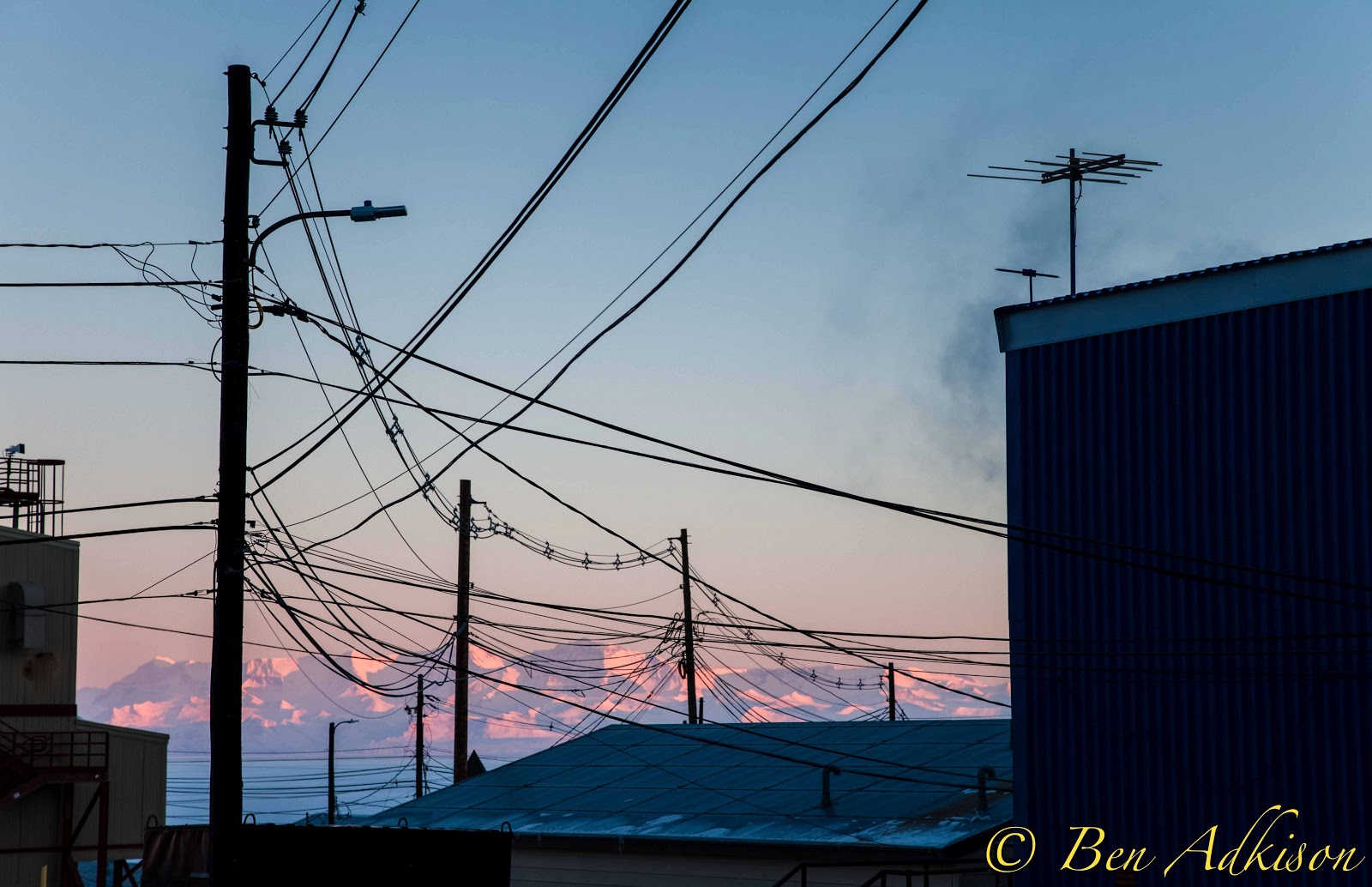
The juxtaposition is interesting with the industrial looking town in the foreground.  I'm excited for the darkness, but I'm also excited for this same type of light to come back in August because it will be even more amazing after a few months of darkness.  


Tuesday, April 16, 2013

I entered a photo contest...

I have a few photos from the last few months that I really like so I decided to pick a few and enter them in a photo contest.  It would be awesome if you have an extra minute to go and vote for them.  


Thanks for the help!